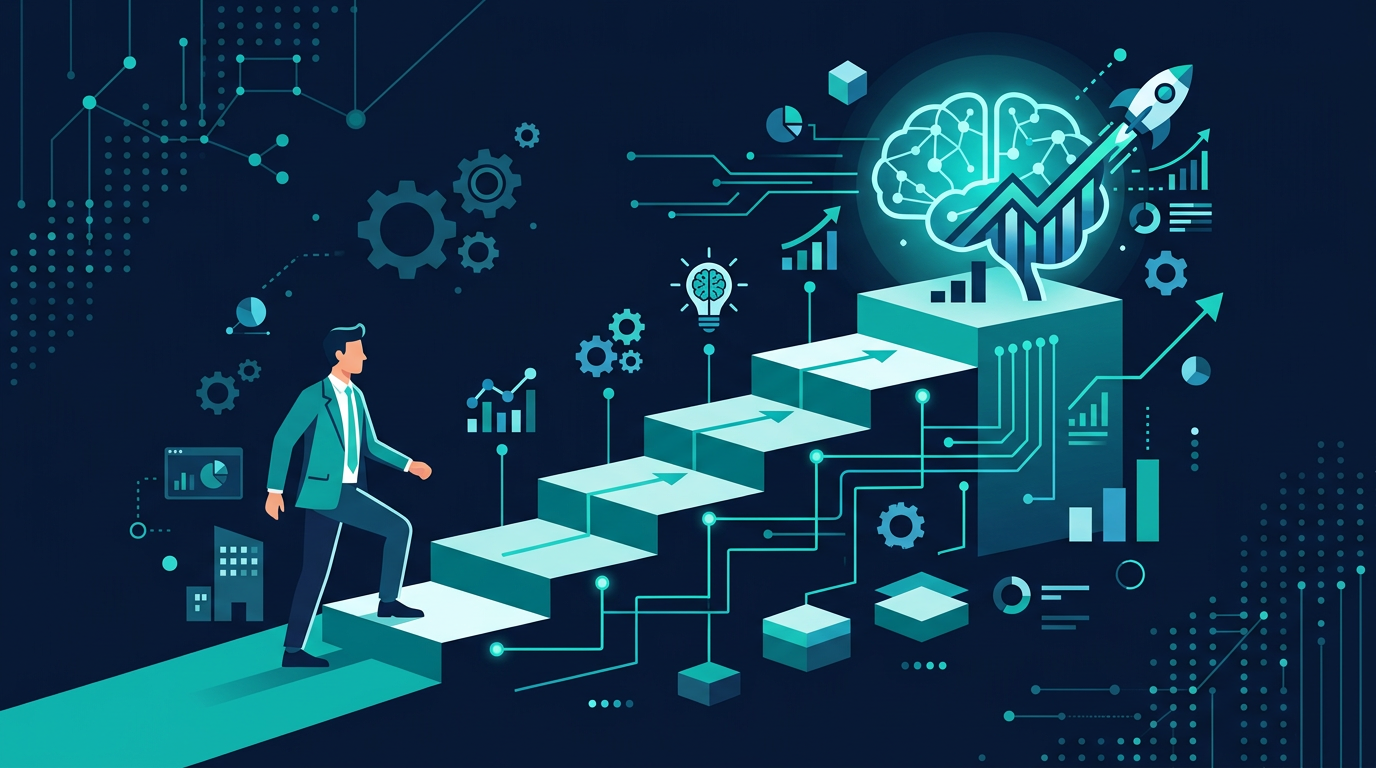
If you're reading this article as a managing director or executive of a mid-sized company, you've probably already heard dozens of talks about AI in the Mittelstand. Most sounded impressive – and still left you clueless. Too abstract, too technical, too far removed from your business reality. This guide is different. No buzzword bingo, no science fiction visions. Instead: concrete applications, honest assessments, and a clear roadmap for your AI entry as an SME.
AI Without Buzzwords: What Artificial Intelligence Really Is (and Isn't)
Let's start with the basics – without marketing speak. Artificial intelligence in business use isn't a thinking machine. It's a tool that excels at three things:
- Pattern recognition: AI finds correlations in large datasets that humans miss – for example, which customers are at risk of churning or which machine parameters lead to failures.
- Automating routine tasks: Anything rule-based and repetitive, AI can do faster and more accurately than humans – from sorting emails to processing invoices.
- Processing text, images, and speech: Generative AI can write texts, analyze images, and understand spoken language. This enables applications from automatic meeting minutes to visual quality control.
What AI cannot do: think creatively, make ethical judgments, build customer relationships, or understand your business. AI is a tool – a very powerful one, but a tool. Humans set the direction.
5 Immediately Actionable AI Applications for SMEs
Forget self-driving factories and fully autonomous decision systems for now. Getting started with AI in mid-sized companies begins with concrete, manageable applications that work today and deliver results within weeks.
1. Intelligent Email Processing
What it does: AI analyzes incoming emails, identifies the content (inquiry, order, complaint, invoice request) and automatically routes them to the right person or department. For standard inquiries, the AI generates response suggestions.
Why it works: Every employee in mid-sized companies spends an average of 2.5 hours per day on emails. Intelligent email processing saves 30–50% of that time.
What you need: An email system (Outlook/Gmail), an automation tool (Make or n8n), and 2–3 days of setup time.
Investment: €200–500 per month.
2. Automated Document Capture
What it does: AI reads incoming invoices, delivery notes, purchase orders, and other business documents, extracts relevant data (amounts, part numbers, addresses) and transfers them to ERP or accounting systems.
Why it works: Manual data entry is error-prone (average error rate: 5–8%) and time-consuming. AI reduces both to a minimum – error rate below 1%, processing time minus 75%.
What you need: An OCR-capable document processing tool and an interface to your ERP or accounting system.
Investment: €300–1,500 per month depending on document volume.
3. AI-Powered Proposal Creation
What it does: Based on a customer inquiry, the AI automatically creates a complete proposal – with correct prices, matching products, and professional formatting. The sales rep reviews and approves.
Why it works: Proposal creation is the biggest time drain in sales for many SMEs. From an average of 3–5 hours down to 15–20 minutes – that gives every sales team massive capacity gains.
What you need: Maintained product data, a CRM system, and historical proposals as training material.
Investment: €500–2,000 per month.
4. Chatbot for Common Customer Inquiries
What it does: An AI-powered chatbot on your website or customer portal answers standard questions about products, delivery times, prices, and order status – instantly and around the clock.
Why it works: 60–80% of all customer inquiries are standard questions that repeat. A well-trained chatbot answers these reliably and frees your service team for complex issues.
What you need: A knowledge base (FAQ, product documentation) and a chatbot tool with AI integration.
Investment: €100–500 per month.
5. Predictive Maintenance
What it does: AI analyzes sensor data from machines and equipment and identifies patterns indicating impending failures – before they occur. Maintenance becomes plannable instead of reactive.
Why it works: Unplanned machine downtime costs manufacturing SMEs an average of €50,000–250,000 per incident. Predictive maintenance reduces unplanned outages by 30–50%.
What you need: Machines with sensors or IoT sensor retrofitting, a data platform, and an analysis tool.
Investment: €1,000–5,000 per month (depending on machinery).
The Most Common AI Mistakes – And How to Avoid Them
In our work with mid-sized companies, we see the same mistakes again and again. Avoid these five classics when starting with AI in the Mittelstand:
Mistake 1: Starting Too Big
The impulse is understandable: if we're doing AI, let's do it right. But companies that start with a company-wide AI transformation project almost always fail. Start small. One process, one team, one measurable goal. When that works, scale.
Mistake 2: Ignoring the Data Foundation
AI is only as good as the data it's based on. If your CRM customer data is outdated, your product master data has gaps, or your process documentation doesn't exist, no AI tool in the world will deliver good results. Invest in data quality first.
Mistake 3: Separating IT and Business Units
AI projects driven only by IT solve the wrong problems. Projects that come only from business units fail at technical implementation. Successful AI projects need mixed teams – people who understand the business problem and people who master the technology.
Mistake 4: Not Bringing Employees Along
The best AI solution is worthless if nobody uses it. Fear of job loss, overwhelm with new technology, or lack of training are the most common reasons for failed AI introductions. Communicate openly about why you're introducing AI (to relieve employees, not replace them), and train thoroughly.
Mistake 5: Treating AI as a One-Time Project
AI isn't an IT project that you set up once and forget. Models need training, data needs maintenance, processes need adaptation. Plan for ongoing support and optimization from the start – either internally or with an external partner.
Your First AI Pilot in 30 Days: The Roadmap
Enough theory. Here's your concrete roadmap for getting started with AI as an SME – realistically achievable in 30 days:
Week 1: Identify the Problem
- Gather feedback from business units: Which recurring tasks consume the most time?
- List the top 5 most time-consuming manual processes.
- Evaluate: Where is structured data already available? Where is ROI most clearly measurable?
- Select one process as a pilot project.
Week 2: Select Solution and Form Team
- Research suitable AI tools for your use case (or seek advice).
- Form a small pilot team: 1 person from the business unit, 1 from IT, 1 decision-maker.
- Define KPIs: What exactly are you measuring? Time savings? Error reduction? Cycle time?
- Create a simple project plan with milestones.
Week 3: Implementation
- Set up the AI tool and connect it to your systems.
- Train the system with existing data (e.g., historical emails, invoices, proposals).
- Run initial tests with real data – in parallel operation with the existing process.
- Collect feedback from the pilot team and make adjustments.
Week 4: Go-Live and Evaluation
- Switch the new process live for the pilot team (initially with manual oversight).
- Measure defined KPIs and compare with baseline.
- Document results, learnings, and improvement potential.
- Create a business case for scaling to additional departments or processes.
Your Next Step: From Guide to Action
AI for mid-sized companies isn't a privilege reserved for corporations or wizardry for tech experts. It's a tool available to every company – if you know where to start.
This guide has given you the knowledge. Now you need the concrete starting point for your company. That's exactly what our free ProcessCheck is for: In a structured analysis, we'll jointly find the process where AI delivers the fastest and greatest leverage in your company – and you'll get a concrete implementation plan.
→ Request your free ProcessCheck at ProzessAutomatisierung.ai and start your first AI pilot.